How Small Businesses Should Use Debt, Advances & Equity | Bayside
Private equity has bought more than $2 trillion worth of companies over the last few years…and now a lot of them can’t get out of those deals easily.
If you run a $1M–$5M service business in South Florida or anywhere in the U.S., that might sound like a “Wall Street problem.” But the same forces that are trapping private equity in deals are quietly changing how your business is judged by buyers, banks, and non‑bank lenders. That matters when you go to raise capital, clean up your debt, or eventually sell.
What’s Actually Happening In Private Equity (And Why You Should Care)
Louis Mosca laid this out well in his recent Forbes piece on why private equity keeps buying companies it can’t sell. Funds are still under pressure to deploy capital into new deals, but exits have slowed, valuations are softer, and the average holding period has stretched. Instead of buying, polishing, and flipping companies quickly, more funds are being forced to sit in deals longer and actually fix operations.
When that happens, the spotlight shifts from “Can we sell this for a higher multiple?” to “Does this business actually throw off reliable cash, and can it comfortably carry its debt?” Lenders and investors start caring a lot more about:
How the debt is structured (short‑term vs. long‑term, stacked vs. simple).
How quickly operating spend turns back into collected cash (your cash conversion).
How protected the downside is if revenue dips or a new location underperforms.
This isn’t just theoretical.
Here’s a composite example of what I’m seeing in the real world:
A multi‑location fitness operator doing about $3.2M in annual revenue.
Strong brand, steady memberships, decent EBITDA on paper.
Over the last 18 months, they opened two new locations and renovated a third.
To move fast, they took on a mix of short‑term products—two revenue‑based advances, a high‑rate term loan, and some equipment financing.
Nothing about the customers, trainers, or locations changed. Classes were full, reviews were good, and the owner was still hustling.
But when a regional group backed by private capital looked at them as a potential roll‑up acquisition, the conversation shifted. Once the buyer’s lenders saw the capital stack, they didn’t see “growing fitness brand with upside.” They saw a business with layered, expensive, short‑term obligations that would need to be cleaned up or refinanced on day one.
Suddenly, the deal was harder to price, harder to finance, and riskier than it looked from the outside. That’s the same lens more banks, PE groups, and sophisticated buyers are using today, because they’re stuck in deals they can’t exit and trying not to repeat mistakes.
Why It Matters And What Owners Get Wrong
If you’re in a likely roll‑up path—multi‑unit fitness, home services, auto services, hospitality—your eventual buyer is probably backed by some form of private capital. They care about your story, your brand, and your growth, but they also care deeply about:
Howclean your capital stack is (how many facilities, what types, what terms).
How predictable your cash flow looks after all debt service.
Whether they can refinance or restructure your obligations without blowing up the economics of the deal.
At the same time, bank lending has stayed cautious and slow. Many owners are feeling the squeeze, especially in markets like Miami where growth opportunities pop up fast—new locations, build‑outs, equipment, hiring ahead of demand.
So what happens?
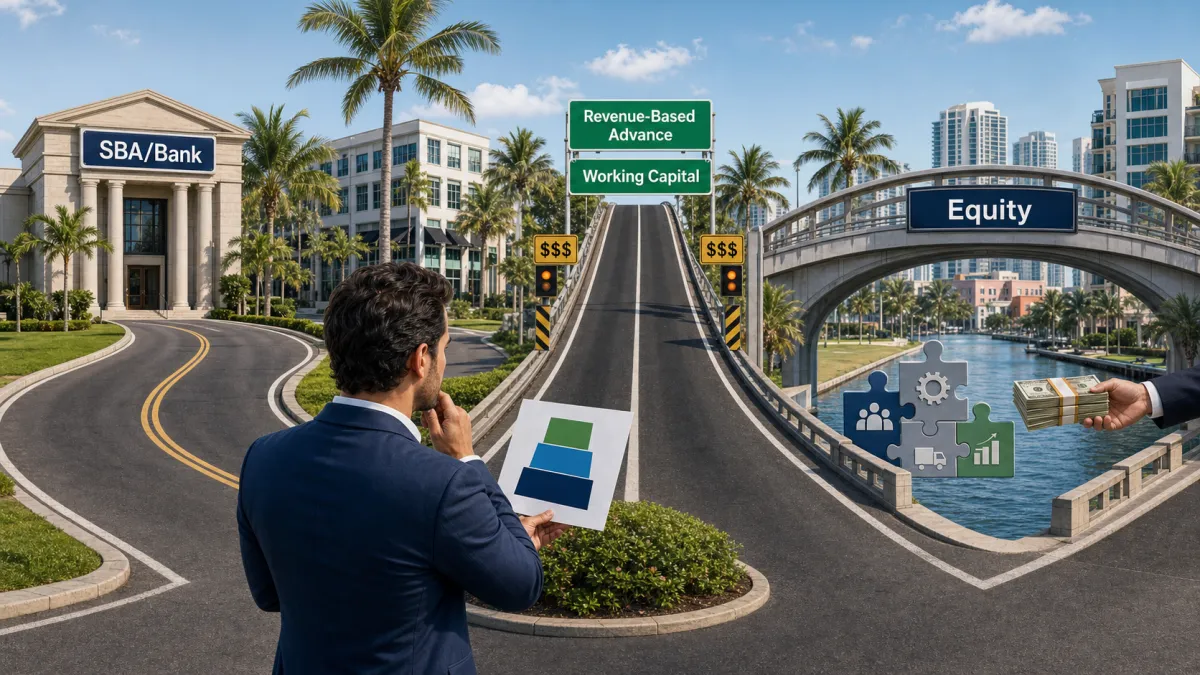
Owners lean harder on non‑bank capital and “creative” funding tools at much higher effective costs: revenue‑based financing, merchant cash advances, term‑style working capital, equipment loans, even selling equity. These tools exist for a reason—they can be flexible, fast, and easier to qualify for than a traditional loan.
The problem is how they’re used.
At Bayside, we’re seeing more solid operators who either:
Stack 2–3 revenue‑based advances to get through a crunch or open the next location, or
Skip straight to giving up equity just to plug a short‑term hole or fund a moderate expansion.
Both can be very expensive strategies if they’re not mapped to a bigger plan. A revenue‑based facility with a 1.2x factor on $100,000 means paying back $120,000 total. If the business pays it back quickly, the effective APR can easily land in the high teens to 30–40%+. Equity is even more expensive long‑term if you’re trading away a big piece of your upside just to solve this year’s cash issue.
Here’s where owners and advisors often get it wrong:
Optimizing for speed instead of structure.
The mindset is “I’ll take whatever funds fastest and clean it up later.” But later rarely happens, because you’re always dealing with the next fire, the next opportunity, the next payroll.Ignoring how a future underwriter or buyer will read the stack.
Most owners look at whether they personally can “handle the payments,” not how the capital structure will look in a diligence room. The same stack that feels “manageable” month to month can make you look distressed to a bank or PE‑backed buyer.Using the right tools for the wrong jobs.
Revenue‑based funding can be smart when you’re using it to finance a marketing push or inventory that turns quickly. It’s much riskier when you’re using it to fund long‑term projects like build‑outs and new locations that take years to fully pay off. Equity can be powerful when it unlocks a step‑change in scale; it’s a bad fit when it’s just covering basic working capital.
The issue usually isn’t the tool itself. It’s using that tool without thinking about what a future buyer or bank is going to see when they open the hood.
That’s how good businesses end up looking like bad deals.
And for me, this isn’t just an intellectual exercise. Getting burned at Vugo—where the company stopped paying me while promising funding that never materialized—and later walking away from a misaligned franchise partnership taught me how dangerous it is to chase the fastest path to growth without aligning incentives and structure.
Capital is a tool, not a trophy; the wrong structure can erase years of work or knock you out of the buyer/lender box you thought you were building toward.
What To Do Instead: Practical Rules For A Clean, Strategic Capital Stack
You don’t have to think like a Wall Street investor to protect yourself. You just need a few practical decision rules you can apply before you sign anything. Here are the ones I come back to with $500k–$5M service owners:
1. Match the tool to the timing of the payoff
If the payoff is short‑term—like seasonal inventory you’ll sell in 3–6 months or a marketing campaign you expect to recover quickly—a higher‑cost, short‑term product can be reasonable.
If the payoff is long‑term—new locations, major renovations, big equipment—you generally want longer‑term, lower‑cost capital even if it takes more time and documentation. Using short‑term, high‑cost money for long‑term projects is where many owners get into trouble.
2. Underwrite your own deal like a buyer or bank would
Before you sign anything, pause and ask:
“If I were buying this business, how would this look?”
“If I were the bank underwriter, would I see this as disciplined growth capital or a band‑aid for deeper cash flow issues?”
If you’d be nervous on the other side of the table, that’s feedback.
3. Look at all‑in cost and cash‑flow impact, not just the headline amount
A $250K approval doesn’t mean much if the total payback and payment schedule choke your operating cash. Lay the proposed payments over your last 6–12 months of bank statements and be honest about where the stress shows up.
Ask: “What happens if I have one slow month? Two? Do I still sleep at night?”
4. Limit stacking and protect your SBA/bank path
One revenue‑based facility or term‑style working capital product, used thoughtfully, can make sense. Stacking multiple short‑term, high‑cost facilities on top of each other is where the red flags start flying for future lenders and buyers.
Create simple guardrails for yourself, like:
“No more than X% of my average monthly revenue in high‑cost, short‑term obligations.”
“No more than Y separate facilities at once.”
That one discipline alone can preserve your path back to SBA or bank financing.
5. Treat equity as your most expensive capital
Selling equity isn’t free money; it’s giving away pieces of every future dollar you earn. If you’re thinking about bringing in a partner or investor, be crystal clear:
What scale does this unlock that debt alone can’t?
How does it change my exit math?
What control, veto rights, or preferences am I handing over?
Using equity to cover short‑term operating gaps is almost always the most expensive way to solve the problem.
6. Build a simple 18–36 month capital roadmap
Instead of treating each funding need as a one‑off—“I need $150K now”—step back and look at the next 18–36 months:
Where do you want the business to be?
How many locations, trucks, chairs, or crews?
What type of buyer or bank do you want at the table when you’re ready?
Work backward from that future conversation to decide what today’s capital should and shouldn’t look like.
Want A Second Set Of Eyes On Your Capital Stack?
If you’re a $500k–$5M service business owner and you’re staring at offers—or debating between stacking expensive advances and giving up equity—you don’t have to guess how it will look to a bank or future buyer.
At Bayside, this is the lane we live in every day: mapping your real cash flow, laying out 2–3 funding options, and stress‑testing each one against your future SBA, bank, and exit options.
If you want a straight, plain‑English view of what a structure will actually do to your business 12–24 months from now, you can start a conversation with me at baysidebusinessadvisors.com.