How to Qualify for Bank Financing: The Strategic Advisor's Guide
Most owners I meet in Miami-Dade don't have a revenue problem. They have a paper problem. The business is real, the cash is moving, and the phone keeps ringing — but the financials don't tell that story cleanly, so the bank says no. That gap between what your business actually does and what your statements prove is where deals die. Bayside is a capital advisor, not a direct lender, and our job is to help you close that gap so you qualify for bank financing on terms that support growth. This guide walks through the 2026 benchmarks that decide whether you get low-cost business expansion financing across North America's tightening credit market — or another expensive workaround.
The 2026 Bankability Gap: Why Cash Flow Alone Isn't Enough
There's a difference between getting capital and qualifying for a structure. Anyone can get capital in 2026 — the internet is full of lenders who will wire you money by Friday. Qualifying for a structure that actually supports long-term growth is a different sport. That's what "bankability" means: your business is positioned to meet the rigid underwriting standards of institutions like Citizens Bank or the SBA, not just the loose standards of whoever answers the phone.
Underwriters look at risk through one primary lens.
Debt Service Coverage Ratio (DSCR) is the primary metric banks use to see if your cash flow can comfortably cover new debt payments. Put simply: for every dollar of debt payment, they want to see meaningfully more than a dollar of income available to cover it.
The 2026 climate makes this stricter, not looser. The Federal Reserve's Beige Book has signaled ongoing caution in commercial lending — banks report tighter credit standards and more scrutiny on cash flow durability. When money costs more, underwriters get pickier about who they lend it to.
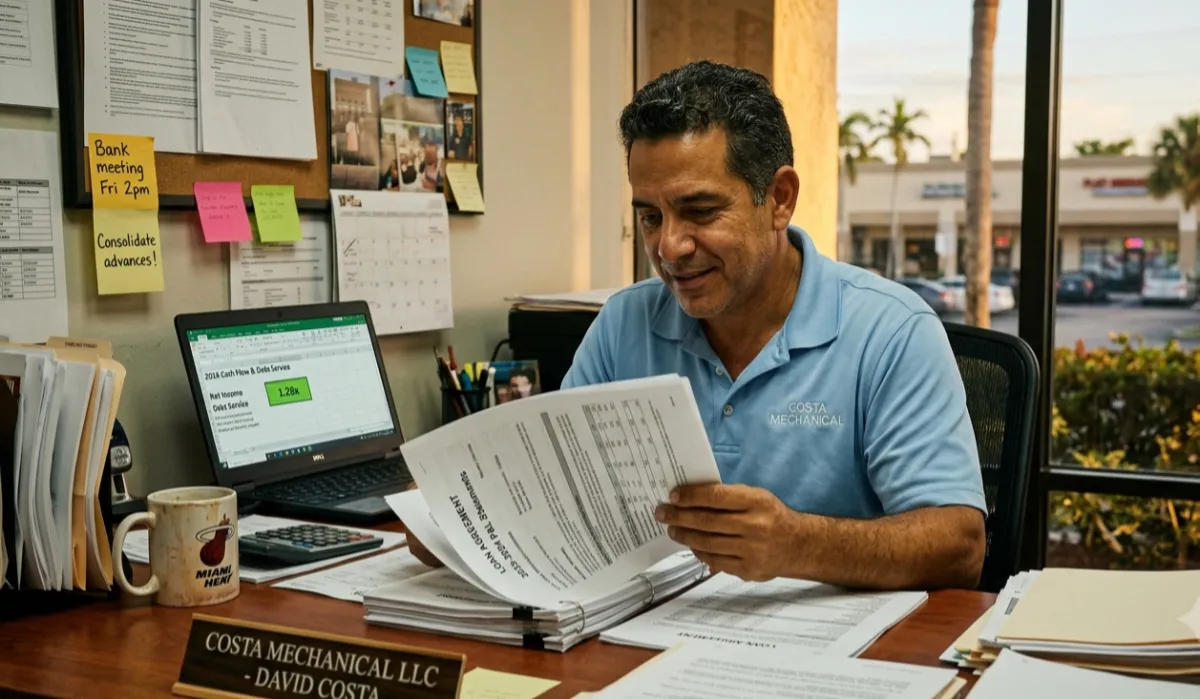
The thing that quietly destroys bankability is stacked advances. When an owner takes a second, third, or fourth cash advance to plug a hole, those daily and weekly debits suffocate the very cash flow a bank needs to see. On paper, your DSCR collapses. A business doing $2M in revenue can look un-fundable simply because three MCAs are eating the operating account every morning.
This is where "strategic before transactional" matters. The owners who win in 2026 aren't chasing the fastest yes. They're building a structure a bank can say yes to — and that takes planning, not hype.
Strengthening Your Balance Sheet: Specific 2026 Underwriting Benchmarks
Competitors love to tell you to have "strong financials." That's useless. Here are the actual numbers banks are targeting this year, so you can run a pre-flight check before you ever walk in.
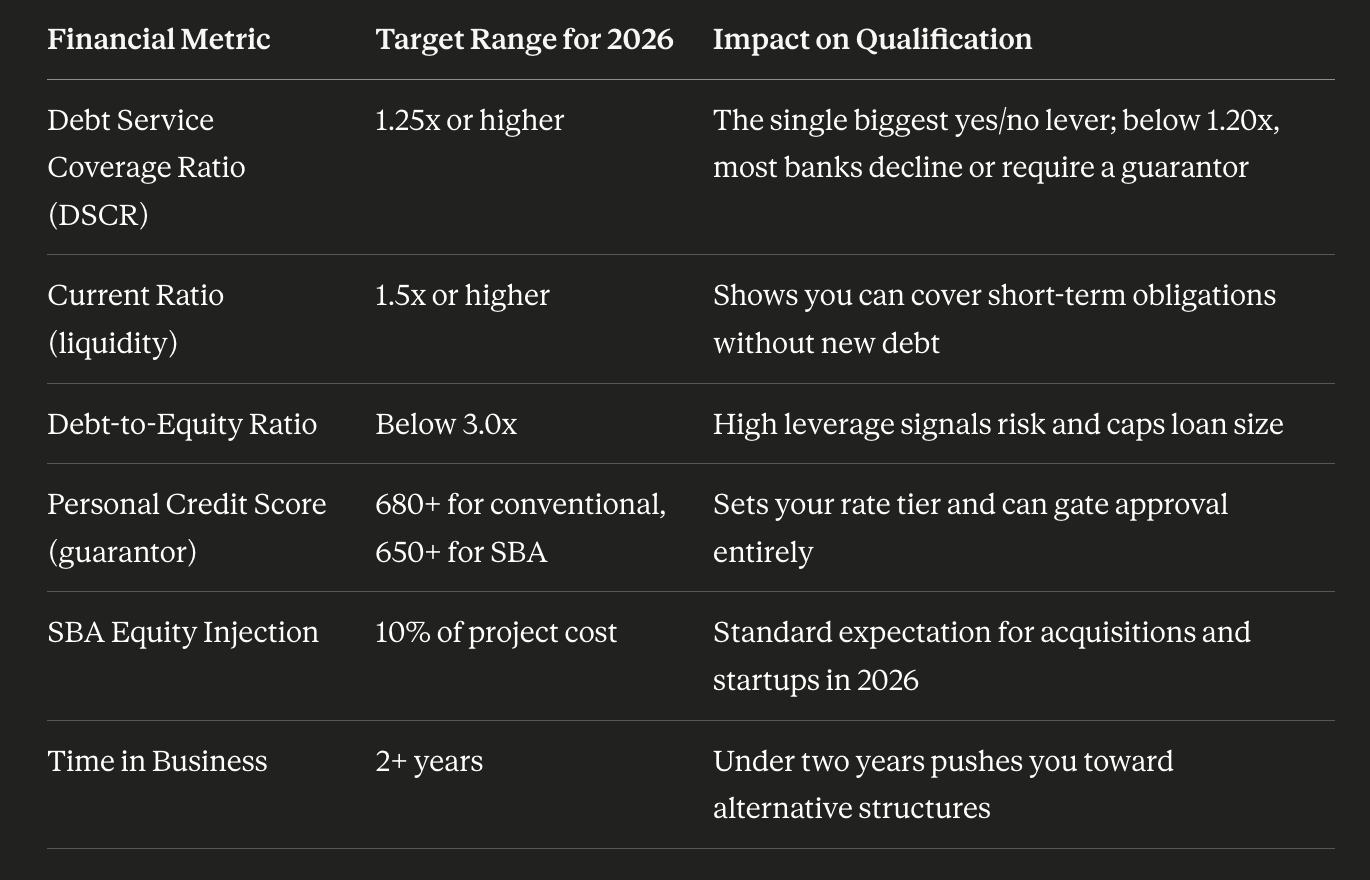
A few things worth explaining. On SBA loan requirements, the Small Business Administration and its lenders generally want a personal credit score in the mid-600s or better, a documented 10% equity injection on acquisitions, and clean personal and business tax returns that reconcile with your bank statements. The 7(a) program remains the workhorse for growing service businesses.
Improving your business credit rating starts with one unglamorous move: separate personal and business liabilities. Run business expenses through business accounts. Get an EIN-based credit profile. Stop paying vendors from your personal card. Underwriters read commingled finances as disorganization, and disorganization reads as risk.
These targets are directional, not gospel. They're subject to lender review and qualification, and they flex by industry — a contractor with lumpy receivables gets read differently than a restaurant with steady daily deposits. Know your number before someone else calculates it for you.
Operational Cleanliness: Using AI and Real-Time Data to Build Trust
Underwriting isn't only about ratios. It's about trust, and in 2026 trust is built with clean, current data. Real-time reporting cuts through the fog of a financial review. When a lender can see your numbers reconcile at a glance, the deal moves. When they have to untangle a shoebox of receipts, the deal stalls — or dies.
Modern underwriters at institutions like Citizens Financial Group increasingly treat automated, well-kept books as a signal of operational maturity. Here are three ways clean data speeds up your commercial bank loan application:
Faster verification. Automated accounting that ties directly to your bank feeds lets an underwriter confirm revenue in hours, not weeks. No back-and-forth requests for "one more statement."
Fewer red flags. Real-time P&Ls catch discrepancies before the bank does, so you fix them on your terms instead of explaining them under pressure.
Stronger projections. Historical data that's actually accurate makes your 12-month forecast credible — and credible forecasts get funded.
This is where fractional CFO services earn their keep. A good fractional CFO builds an "underwriter-ready" package: reconciled statements, a clean debt schedule, and projections that hold up to questions. It's the difference between handing a bank a story and handing them proof.
Keep in mind that FDIC-regulated institutions operate under documentation standards that don't bend for a good personality. In 2026, "shoebox accounting" isn't quaint — it's a deal-killer. Technology adoption is no longer optional. It's the prerequisite for the best funding structures.
Bridge Financing and Strategic Funding Structures
Not every business is bankable today. That's fine — the goal is to be bankable tomorrow, and there's a smart middle ground to get you there. The mistake is treating bridge capital as a destination instead of what it is: a bridge.
Asset-based lending and invoice factoring let you unlock capital you already have. If you're a service business waiting 60 days on receivables, factoring turns those invoices into working capital now — and the invoice factoring benefits include funding growth without adding a rigid new monthly payment. Revenue-based financing flexes repayment with your sales, giving you room to grow without the tight covenants of a bank term loan. Specialty finance firms like eCapital exist precisely to support a business while it cleans up its balance sheet and earns its way to bankability.
Collateral matters here too. A Miami-based contractor can use owned CNC machines as collateral to secure an equipment lease, freeing cash for payroll and materials while keeping the bank relationship intact. The principle underneath all of it: match your payback speed to how fast the capital earns its keep.
Match Your Payback Speed to Asset Life
Business reality: the term of your debt should match the lifespan of what you're buying. You don't finance a ten-year piece of equipment with a nine-month advance, and you don't fund a permanent expansion with short-term bridge money. Short-term bridge debt is for immediate, high-ROI needs — a rush inventory buy, a receivable gap. When you mismatch the two, the payment schedule outruns the return, and you're back to stacking.
The Role of a Strategic Capital Advisor
A loan officer sells you a product. A capital advisor builds you a structure. That's the whole difference. I sat with an owner last week who was over-leveraged across three advances and about to take a fourth. He didn't need another loan — he needed someone to unwind the stack, protect his DSCR, and map a path to a real bank facility. That's advisory work, and it's the opposite of chasing a commission.
The 5-Step Roadmap to Bankability in 2026
Here's what a street-smart owner does now:
Run a no-pressure debt review. List every advance, loan, and lease with its true cost and daily or weekly drain. You can't fix a stack you haven't mapped.
Optimize your DSCR. Consolidate high-frequency payments into a single, slower structure so your cash flow can breathe and your coverage ratio recovers.
Build 12-month projections. Use fractional CFO services to create forecasts a bank will actually believe, tied to real historical data.
Address credit blemishes. Get on the improving-business-credit-rating path — separate accounts, dispute errors, pay down revolving balances before you apply.
Prepare a Capital Readiness folder. Three years of tax returns, clean monthly P&Ls, a current debt schedule, and your use-of-proceeds plan, all in one place.
Do these five things and you stop hoping for a yes. You engineer one.
Frequently Asked Questions
How can a company improve its financial performance for bank qualification? To qualify for bank financing, companies should focus on increasing their Debt Service Coverage Ratio (DSCR) to at least 1.25x. This involves reducing short-term liabilities, like high-interest cash advances, and ensuring all revenue is documented through clean, monthly P&L statements that reflect real-time business health.
What is the $3000 rule for banks? While not a formal regulation, the "$3000 rule" often refers to the threshold where banks require more intensive documentation or favorable-balance checks for daily operations. In 2026, maintaining a consistent daily balance above this level signals liquidity and operational stability to bank underwriters during the review process.
What source of finance is most suitable for a growing and profitable business seeking further expansion? For a profitable company, a traditional bank term loan or an SBA 7(a) loan is usually most suitable. These structures offer the lowest interest rates and longest repayment terms, preserving your cash flow for operations rather than aggressive debt service.
What do lenders look for when financing business growth? Lenders prioritize bankability, which includes a strong DSCR, a healthy debt-to-equity ratio, and significant industry experience. They also look for a clear use-of-proceeds plan that demonstrates how the capital will generate enough new revenue to cover repayment without stressing the business.
What are the advantages of working with a fractional CFO during expansion? A fractional CFO provides the strategic financial leadership needed to clean up balance sheets and prepare underwriter-ready documents. They help you navigate complex financial ratios and ensure your growth plan is realistic, which significantly increases your chances of qualifying for lower-cost bank financing.
How far in advance should I seek financing for my South Florida business? You should begin the capital advisory process at least 6 to 12 months before you need the funds. Bank financing is a marathon, not a sprint. Early preparation lets you fix credit issues and improve your bankability profile before the actual application.
Can a business expand in 2026 without taking on additional debt? Yes. Businesses can use non-debt structures like invoice factoring or trade credit. These options let you access your own working capital — money already owed to you — to fund expansion without adding a new monthly payment to your balance sheet.
How much financing should my company realistically seek? Seek an amount that covers your expansion needs plus a 10–20% working capital cushion. But the final amount is limited by your DSCR; you should never borrow so much that your debt payments exceed 80% of your net operating income.
Conclusion: Protecting Your Bankability
Funding is supposed to support your operations, not suffocate them. The owners who thrive in 2026 treat capital as a tool with a right and wrong way to use it — matched to the asset, sized to the cash flow, and structured to keep the door to low-cost bank debt open. That's the whole game: protect your bankability today so you have options tomorrow. Bayside is the advisor in your corner for exactly that. If you're staring at a couple of offers and not sure which way to go, share a bit about your situation and we'll walk through it with you.