

Business Recapitalization: A South Florida Guide
You run a solid business. Revenue is up, the phones ring, and on paper you look strong. But every month a chunk of that revenue disappears into debt payments you took on years ago, and the cash never seems to catch up. The business is healthy — the structure underneath it isn't. That gap is exactly what a recapitalization fixes. Recapitalization means restructuring your business's debt and equity mix to improve cash flow and protect your future options. Bayside Business Advisors is a capital advisor, not a lender, which means our job is to help you see the whole board — not sell you one product. This 2026 guide walks through the structures, the real costs, and how smart capital structure optimization protects your bankability. These are recapitalization advisory services built around your long game.
What is Recapitalization Advisory and Why Does Your Structure Matter?
Capital structure is just the balance between what you own and what you owe — the mix of debt and equity funding your operations. When that mix drifts out of line, good businesses start feeling squeezed even in good years. A recapitalization advisor reviews your numbers the same way an underwriter would, looking for the "fog" in your current setup: the short-term debt that should be long-term, the payment stack that's throttling cash, the balance sheet that scares off the next lender.
A recap generally serves one of three goals:
Liquidity for shareholders — taking some cash off the table without selling the business
Expansion capital — funding growth without choking daily operations
Balance sheet flexibility — reducing leverage so future financing stays open
A one-product lender sells you what's on their shelf. A strategic capital advisor looks at the whole picture. We anchor those conversations in EBITDA — your earnings before the accounting noise of interest and taxes — because it's the cleanest read on what your business actually produces. National firms like Mirus Capital Advisors chase massive corporate deals. Bayside works the local $500K–$5M revenue SMB market, where the owner's name is on the loan.
Strategic Recapitalization Types: Navigating the 2026 Market
There's no single "right" recap. The structure depends on what you're solving for. Three approaches cover most of what South Florida owners actually need in 2026, and the smart move is comparing them side by side before anyone signs anything. Think of these as funding structures that support operations, not suffocate them.
Leveraged recapitalization uses new debt to pay the owner a dividend — you pull liquidity out without selling equity. The interest on that debt is generally deductible, the "tax shield" that makes the math work. Equity recapitalization brings on a partner or investor to pay down debt; you trade some ownership dilution for a stronger, more stable balance sheet. Debt-to-equity ratio restructuring rebalances those two numbers directly — reshaping your debt-stack to improve long-term bankability.
In 2026, private credit lenders have expanded the toolkit, often offering more flexibility than traditional banks for middle market recapitalization and structured deals. Asset-based lending — borrowing against equipment, inventory, or receivables — is a common component for businesses with real collateral on the books.
Leveraged Recapitalization for Shareholder Liquidity
Picture a founder who's built fifteen years of equity but hasn't taken real money off the table. A leveraged recapitalization lets her pull a cash dividend funded by new debt while keeping majority control. She de-risks her personal finances, the business keeps running, and the interest expense works as a tax shield. She gets liquidity for shareholders without giving up the company she built.
Equity Recapitalization for Growth
Now picture an owner ready to open a second and third location but tapped out on borrowing capacity. An equity recapitalization brings in a partner whose capital pays down existing debt and funds the expansion. He gives up some ownership, but he gains a cleaner balance sheet and the expansion capital to enter new markets — growth he couldn't have financed on debt alone.
The Recapitalization Process: From Review to Closing
A good recap is a methodology, not a scramble. Here's how it runs, and at every step you are not just a file in a national system.
The No-Pressure Review. A confidential look at your financials — no hard credit pull, no obligation. We tell you honestly what's realistic before anything else happens.
Modeling Outcomes. We compare multiple funding structures side by side so you can see the real trade-offs in cash flow, cost, and control.
Selecting the Partner. We match you to the right source from Bayside's network of independent, approved funding partners — bank, private credit, or asset-based.
Underwriting and Due Diligence. We review your numbers the same way underwriters do, so there are no surprises when the file hits their desk.
Closing and Integration. We make sure the new capital lands cleanly and supports operations from day one.
Industry-Specific Restructuring: Miami's 2026 Outlook
South Florida businesses don't all break the same way. The right structure depends on your sector's cash flow rhythm.
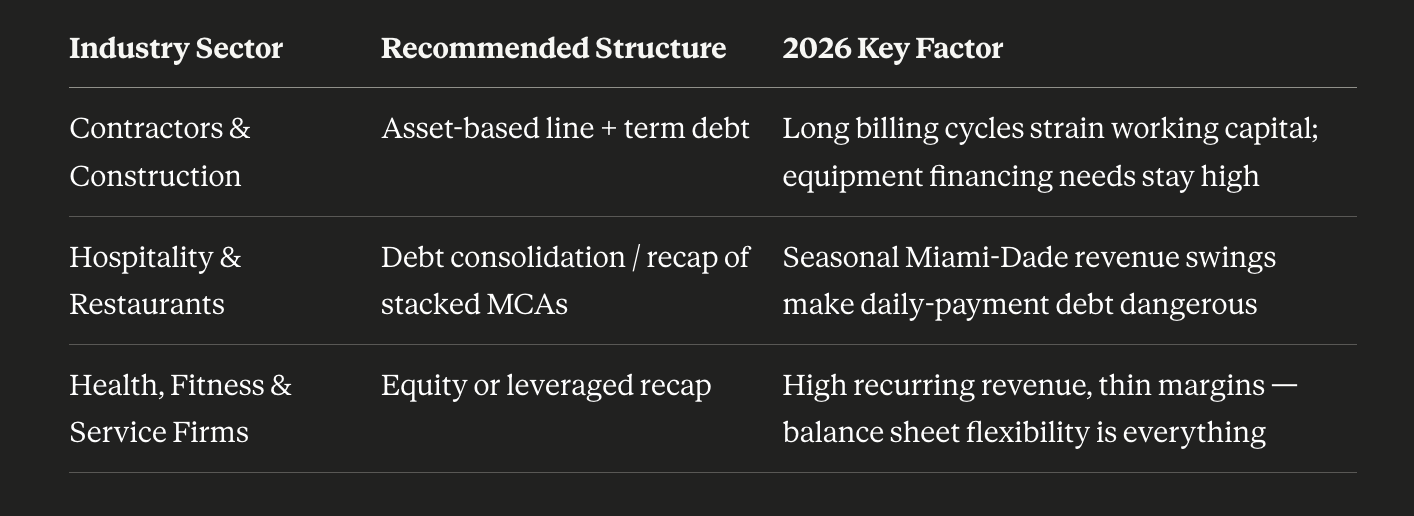
Contractors get squeezed waiting 60 to 90 days on draws while payroll and equipment don't wait. Restaurants living on high daily expenses too often stack MCAs until the daily debits eat the register — recapitalizing that debt into a single sane structure can save the business. Service firms with strong recurring revenue but thin margins need room to breathe, and that room comes from balance sheet flexibility.
Understanding Advisory Costs: Success Fees and Retainers
Most owners have never been told how advisors actually get paid, so here it is plain. A retainer is an upfront commitment paid before the work. A success fee is paid only when the deal closes — advisor and owner rowing the same direction.
Bayside Business Advisors LLC does not charge upfront fees. We start with a no-pressure review and tell you what's realistic before money enters the conversation. The real cost to watch isn't the advisory fee — it's the hidden price of grabbing the wrong "instant approval" deal that looks fast today and strangles cash flow for two years. Fees vary with the complexity of the deal, the size of the business, and the final funding structure.
Quick Review: When advisory fees do apply on a closed deal, success fees are typically a single-digit percentage of capital raised, occasionally paired with a modest retainer on complex engagements. No upfront cost to find out where you stand.
2026 Tax and Regulatory Considerations for Recapitalization
The 2026 tax environment still rewards structure. Interest on recap debt is generally deductible — the "tax shield" that makes leveraged recaps efficient — but the details matter. Dividend recaps in particular can trigger IRS scrutiny if structured carelessly, and the last thing you want is a liquidity move that becomes an unexpected tax bill. Watch the shifting rules for SME borrowers, where sources like the Middle Market Monitor track how private credit and regulatory changes are reshaping terms.
Pro Tip: Before you file for 2026, model the tax impact of any recap alongside your CPA — timing a dividend recap around your fiscal year can change the outcome materially.
Disclaimer: Tax outcomes may vary based on individual business circumstances. Always consult a qualified CPA or tax advisor before acting.
Frequently Asked Questions
How do companies strengthen the balance sheet in 2026? Companies strengthen the balance sheet by optimizing their debt-to-equity ratio, often through recapitalization advisory services. This involves replacing high-cost short-term debt with long-term funding structures or injecting equity to reduce leverage, which improves cash flow and increases your business's long-term bankability for future financing.
How can I increase capital in my balance sheet? You can increase capital through equity recapitalization, where you bring on an outside investor or partner in exchange for shares. This provides an immediate cash injection without increasing your debt load, allowing you to pay down existing liabilities and create a more stable financial foundation for growth.
What does it mean to recapitalize a balance sheet? To recapitalize a balance sheet means to strategically reorganize a company's financial structure. This process changes the mix of debt and equity used to fund operations. The goal is typically to improve liquidity, reduce the cost of capital, or provide a bridge to future corporate actions like an exit.
What is the recapitalization process for small to medium-sized businesses? For SMBs, the process involves a thorough review of financial records, identifying capital needs, and negotiating with a network of independent funding partners. A strategic capital advisor helps you model different scenarios to ensure the chosen structure supports your operations rather than suffocating your cash flow.
When is the right time to consider recapitalization? The right time to recapitalize is when your current debt structure limits your ability to grow, or when you face high-interest maturities in a shifting rate environment. It is also common for founders seeking partial liquidity to de-risk their personal finances without fully exiting the business.
What is the difference between debt and equity recapitalization? Debt recapitalization involves taking on new loans or credit lines to replace existing capital, often to buy back shares or fund growth. Equity recapitalization involves issuing new shares to raise capital, which reduces debt but dilutes ownership. A capital advisor helps you weigh the tradeoffs of each.
How long does a typical recapitalization transaction take to execute? Most recapitalization transactions take between 60 to 120 days, depending on the complexity of the business and the chosen structure. The process includes financial modeling, lender/investor due diligence, and legal documentation. Proactive planning is essential to ensure the timing aligns with your growth objectives.
How does a leveraged recapitalization impact shareholder value? A leveraged recapitalization can increase shareholder value by providing an immediate cash dividend while allowing owners to retain majority control. By using debt to replace equity, the business may also benefit from tax deductions on interest payments, potentially increasing the return on remaining equity.
How do private credit lenders influence the recapitalization market? Private credit lenders have expanded the toolkit for recapitalization in 2026, offering more flexible terms than traditional banks. They often provide structured capital solutions that combine elements of debt and equity, allowing business owners to customize their funding to match their specific cash flow cycles.
What are the typical fees for recapitalization advisory services? Advisory fees typically consist of a success fee, which is a percentage of the total capital raised, and sometimes a small monthly retainer for complex projects. At Bayside, we focus on a no-pressure review to tell you honestly what is realistic before any fees are discussed.
Your structure should serve your business, not the other way around. If the numbers look strong but the cash feels tight, that's worth a conversation. Explore your options with Bayside.