
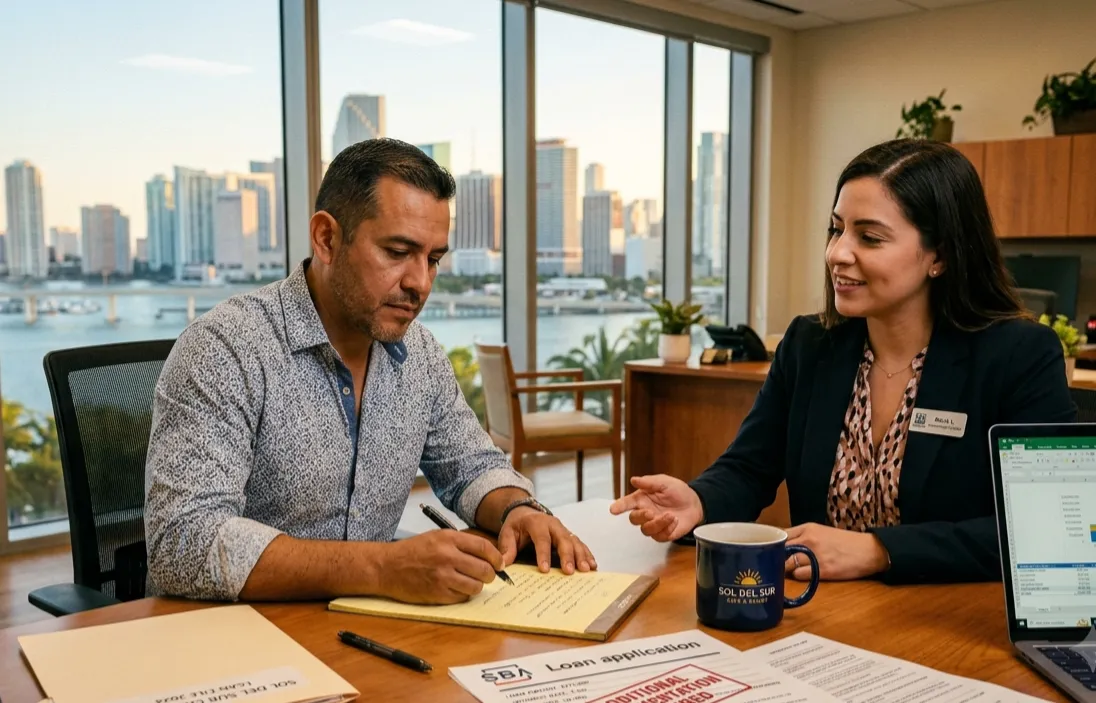
The SBA Just Changed What Counts as "We Got Turned Down by the Bank" — Here's What South Florida Owners Need to Prove Now
If you're planning to walk into an SBA loan application this year with "our bank said no" as your story, that's not going to cut it anymore. The SBA tightened its eligibility standard, and lenders can no longer document your case with a generic checkbox. They now have to show — in writing, with real numbers — exactly why conventional financing wasn't reasonably available to you. If you run a $500k–$5M service business in South Florida and you're gearing up for an SBA 7(a) or 504 loan this year, you need to understand this shift before you apply, not after your lender comes back asking for documents you don't have.
SECTION 1 — WHAT'S ACTUALLY HAPPENING
For years, SBA lenders could document a borrower's inability to get conventional credit with a fairly standardized justification — a short paragraph, a box checked, and the file moved forward. That's over. The SBA has walked back a lot of the pandemic-era flexibility that made 7(a) and 504 loans easier to access, and one of the biggest changes is on the credit-elsewhere test — the rule that says SBA loans are supposed to go to borrowers who genuinely can't get reasonable financing elsewhere. Lenders are now required to actually document that: reviewing your liquidity, your personal resources, and your specific credit weaknesses, and building a real case for why a bank wouldn't have said yes on its own terms.
At the same time, the streamlined processing threshold for 7(a) loans got cut — loans that used to sail through simplified underwriting up to $500,000 now only get that treatment up to $350,000. Anything between $350,001 and $500,000 needs full underwriting: comprehensive financial analysis, a detailed credit memo, the whole file. That's a meaningful number of South Florida service businesses — landscaping companies, med spas, logistics operators, contractors — that used to fit neatly into a fast-track SBA process and now don't.
I had a client a few months back, a commercial cleaning company doing about $2.8M a year, who came to me assuming his SBA application would move the way his last one did in 2022. He needed $425,000 for a fleet expansion. Last time around, that would have been a streamlined file. This time, his lender needed a full credit memo, a debt service coverage ratio well above the SBA's 1.15 floor, and a written explanation of exactly why his bank had declined him — not just that they had. We had to go back and rebuild his documentation almost from scratch, and it cost him three weeks he didn't think he had.
SECTION 2 — WHY IT MATTERS AND WHAT OWNERS GET WRONG
The mistake I see constantly is owners treating "the bank said no" as self-explanatory. It isn't, not anymore. Lenders need specifics: what your bank's underwriting looked at, what it flagged, and why your business's overall financial picture — cash flow, collateral, personal resources — still supports repayment even though a conventional lender passed. If you can't articulate that clearly, your SBA lender is stuck building the case themselves, which slows everything down or gets the file kicked back.
The second mistake is underestimating how much weight your debt service coverage ratio (DSCR) and collateral position now carry relative to your credit score alone. SBA underwriters still care about your FICO, but a 680 with a DSCR sitting right at the 1.15 floor and no meaningful collateral coverage is a much weaker file than it would have been three years ago. Lenders are actively looking for compensating factors now — a DSCR closer to 1.35, collateral coverage above 100% of the loan amount, five-plus years of industry experience, a clean 24-month payment history on existing business debt. If you're missing two or three of those, your file needs to work harder everywhere else.
The downstream consequence is what really stings: owners who get denied or delayed on an SBA application often pivot straight to a merchant cash advance or a stacked short-term product to bridge the gap while they regroup — and that decision alone can create the exact cash flow strain and balance sheet damage that makes qualifying for anything cheaper even harder next time. It's not just a paperwork problem. A messy SBA application this year can trigger a chain of expensive decisions next year.
Citizenship and ownership verification also got stricter — only U.S. citizens can access SBA-backed loans now, and lenders have to validate ownership structures more thoroughly, including full disclosure and residency confirmation. If your business has any complexity in ownership — partners, investors, family members with equity stakes — that needs to be buttoned up before you apply, not discovered mid-underwriting.
SECTION 3 — WHAT TO DO INSTEAD
Build your "why we couldn't get conventional credit" narrative before you apply, not after your lender asks. Get your bank decline in writing if you have one, and be ready to speak specifically to what they flagged.
Know your DSCR before your lender tells you. If you're sitting near the 1.15 floor, work on the ratio — pay down short-term debt, tighten receivables, or delay the request until your cash flow trend supports a stronger number.
Get your collateral picture organized. If you're under 100% coverage on the loan amount, know that going in, and be ready to explain how the rest of your file compensates for it.
Clean up your ownership structure documentation now. Full disclosure, U.S. residency confirmation, and clear equity breakdowns should be ready before your lender asks.
If your loan need is between $350,000 and $500,000, plan for full underwriting timelines, not streamlined ones. Build in extra weeks, not extra days.
CLOSING CTA
If you're planning an SBA application this year and you're not sure whether your file would hold up under the new documentation standard, let's take a look before you're deep into underwriting and scrambling to fill gaps. I'll walk through your DSCR, your collateral position, and what your file actually needs to say. You can share a bit about your situation here: https://baysidebusinessadvisors.com/submit