SBA vs Non-SBA Loans: What Service Business Owners Need to Know | Bayside Business Advisors
If you run a $500k–$5M service business in this market, you’ve probably heard some version of: “If you can get SBA, you should always get SBA.” On paper, it sounds right. Lower rates, longer terms, smaller payments — what’s not to like?
But when you’re staring at a lease deadline, a build‑out schedule, or a contractor who wants a deposit next week, the conversation changes. Suddenly, it’s not just “SBA vs everything else.” It’s “Do I wait for the ‘holy grail’ or take a more expensive term loan that can actually close before I lose this opportunity?”
What’s actually happening when you compare SBA to a non‑SBA term loan
Let’s ground this in a real scenario.
A few months ago, I sat down with a restaurant owner doing around $1.2M a year. The first location was stable. The neighborhood was filling in. A second space opened just a few blocks away — good visibility, decent rent, landlord ready to move. It was one of those chances that might not come back around.
His bank said, “We might be able to do an SBA 7(a) if we clear a few things.” Translation:
They liked the business in general.
They had questions about existing debt and cash flow.
Underwriting was going to be a process, not a formality.
Meanwhile, he had a non‑SBA term loan offer from another lender. Higher rate, shorter term, bigger monthly nut — but they were ready to close in a fraction of the time.
Here’s how I walked him through the differences, stripped of myth and marketing:
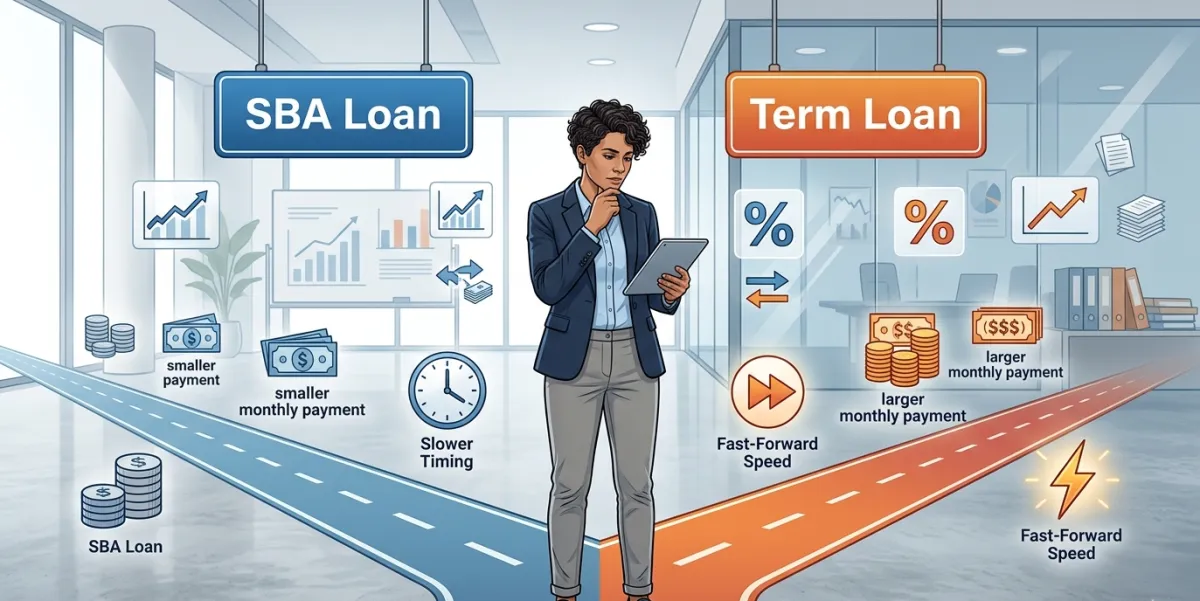
SBA is designed to be the cheapest, longest‑term option on the table. Think lower interest rate, longer amortization (often 10 years or more), and smaller monthly payments that free up cash for staffing, inventory, and marketing. In exchange, you give them patience, documentation, and a structure that fits their rules — including today’s all‑citizen ownership requirement.
A conventional or non‑bank term loan usually sits in the middle. Rates are higher than SBA, terms are shorter, and payments are bigger, but you get less friction, faster decisions, and more tolerance for “real‑world” files that aren’t perfectly clean.
SBA underwriters are obsessed — correctly — with global cash flow, existing debt, and how the whole package holds up in a downturn. If you already have stacked short‑term obligations or thin margins, they will dig into that or say no.
Term‑style lenders lean heavily on recent performance and bank activity. If your revenue can clearly support the payment and the use of funds makes sense, they’ll often move even when the story isn’t spotless.
In the restaurant owner’s case, SBA looked beautiful on a spreadsheet: lower monthly payment, more breathing room, better long‑term economics. But the reality was that his landlord wasn’t going to hold an empty space for months while SBA underwriting played out, and his current capital stack meant there was a non‑zero chance of a “no” at the end of that process.
That’s the tension most owners are actually sitting in — not “good vs bad,” but “ideal but uncertain vs more expensive but real.”
Why owners get burned: the “temporary” move that isn’t
Where things go sideways is how owners think about sequencing.
The pattern I see all the time at Bayside looks something like this:
Owner gets interested in SBA. They talk to their bank, maybe start an application, hear some positive signals.
Underwriting drags. More documents, more questions about their existing debt, more back‑and‑forth about projections and global cash flow.
Meanwhile, the opportunity clock is ticking — a lease, a build‑out, a time‑sensitive expansion.
Another lender offers a non‑SBA term loan they can close quickly. The owner says, “We’ll just grab this for now and refinance into SBA in a year.”
The term loan ends up structured in a way that leaves them tight on coverage, layered with guarantees and prepayment penalties. When they go back for SBA later, they discover that the new debt actually weakened their case.
On the surface, it feels logical: “I’ll take what I can get now and clean it up later.” In practice, that first move often decides what’s possible later.
Here’s why:
Debt service coverage matters more than marketing materials let on. If your new monthly payment eats too much of your free cash flow, SBA underwriters will hesitate — regardless of your story.
Prepayment penalties and lock‑outs can trap you in a high‑cost structure longer than you planned. You may be technically allowed to refinance, but it’s expensive enough that it stops making sense.
The way your debt is layered (who has liens, what’s personally guaranteed, how much is secured vs unsecured) can either make an SBA deal straightforward or a maze.
The wrong first term loan can box you out of the SBA bucket you were aiming for in the first place. That’s the part nobody puts in the brochure.
This isn’t theory for me. I’ve been in businesses where we grabbed whatever capital we could because timing was tight and growth felt urgent, telling ourselves, “We’ll sort it out later.” Later usually came with fewer options, more pressure, and a higher bar to qualify for the cheaper money we thought was waiting for us.
How to decide: SBA vs non‑SBA term loan
So if it’s not “SBA good, everything else bad,” how should you think about this choice? Here’s the framework I use with owners.
1. Start with use of funds and timing
Ask two questions:
What exactly is this money for?
How long before that investment realistically starts paying you back?
If the use of funds has a long payoff period — a build‑out, major equipment, a second location — that pushes you toward longer‑term, lower‑payment structures like SBA or longer non‑SBA terms. If the payoff is faster and more discrete, a shorter term may be workable.
Then layer in timing:
Do you have months, or weeks, before you have to commit?
What happens if the deal or space goes away?
If the opportunity disappears forever without a commitment in 30–60 days, you have to weigh that reality against the theoretical benefits of SBA.
2. Underwrite yourself like a lender
Before you talk to anyone, grab your numbers and underwrite your own business the way a lender would:
What is your true debt service coverage ratio if you add this new payment?
Are you already carrying high‑cost short‑term debt (MCAs, cash advances, or maxed‑out lines)?
How clean are your financials and tax returns for the last two years?
If you’re already tight on coverage or carrying stacked short‑term obligations, you’re asking SBA to work uphill. That doesn’t mean it’s impossible, but it does mean you have to be realistic about probability and timeline.
3. Compare structures, not just rates
When you get actual offers, don’t stop at the headline rate. Put them side by side and ask:
What is the monthly payment?
How long am I committed for?
Are there prepayment penalties or lock‑out periods?
What collateral and guarantees are required?
SBA may have the lowest rate, but if the process is slow and the approval uncertain, you have to account for the risk of “no” after months of waiting. A non‑SBA term loan may look more expensive, but if it fits your cash flow and gets the deal done while the window is open, it might be the right strategic move.
4. Don’t assume “I’ll refinance later”
Treat any structure you sign as if you might have to live with it for the full term. If it only works in your mind because “we’ll refinance into SBA in 12 months,” you’re building your capital plan on a maybe.
My rule of thumb: every dollar you borrow should move you toward more flexible, lower‑cost options later, not away from them. That means:
Leaving enough coverage so SBA or bank underwriting can get comfortable down the line.
Avoiding structures that saddle you with heavy prepayment penalties or convoluted collateral.
Being honest about your ability to produce the kind of financials SBA will want to see in 12–24 months.
5. Get a neutral second opinion
Most owners don’t have time to become experts in SBA SOPs, bank credit policies, and non‑bank term sheets — nor should you. But you can put someone at the table who understands how these pieces fit together and isn’t incentivized to cram you into a single product.
Sometimes that means saying, “SBA is worth waiting for — here’s how we shore up your file and timing.” Other times it’s, “Given where you are and the window you’re working with, this non‑SBA term structure is actually the right tool, as long as we avoid these specific landmines.”
If you’re weighing SBA vs a term loan right now
If you’re a $500k–$5M service business trying to decide between an SBA path and a faster term loan, you’re not choosing between good and bad — you’re choosing between two very different tools in a market that’s still tight and picky. The risk isn’t that you pick the “wrong” label; it’s that you pick a structure that solves this month’s problem while quietly killing your options 12–24 months from now.
At Bayside, this is the kind of work we do every day: mapping how each option will actually feel against your cash flow, how it will look to banks and SBA later, and which sequence of moves keeps your future options open instead of closing them.
If you’re looking at SBA vs non‑SBA offers and want a straight, no‑BS review of what each one really does to your business, you can share your situation with us here and we’ll walk through it with you: https://baysidebusinessadvisors.com/explore-options.baysidebusinessadvisors