The Summer Cash Crunch Trap: Why the Fast Money You Take in July Could Lock You Out of an SBA Loan for a Year
It's June. You can already feel August coming.
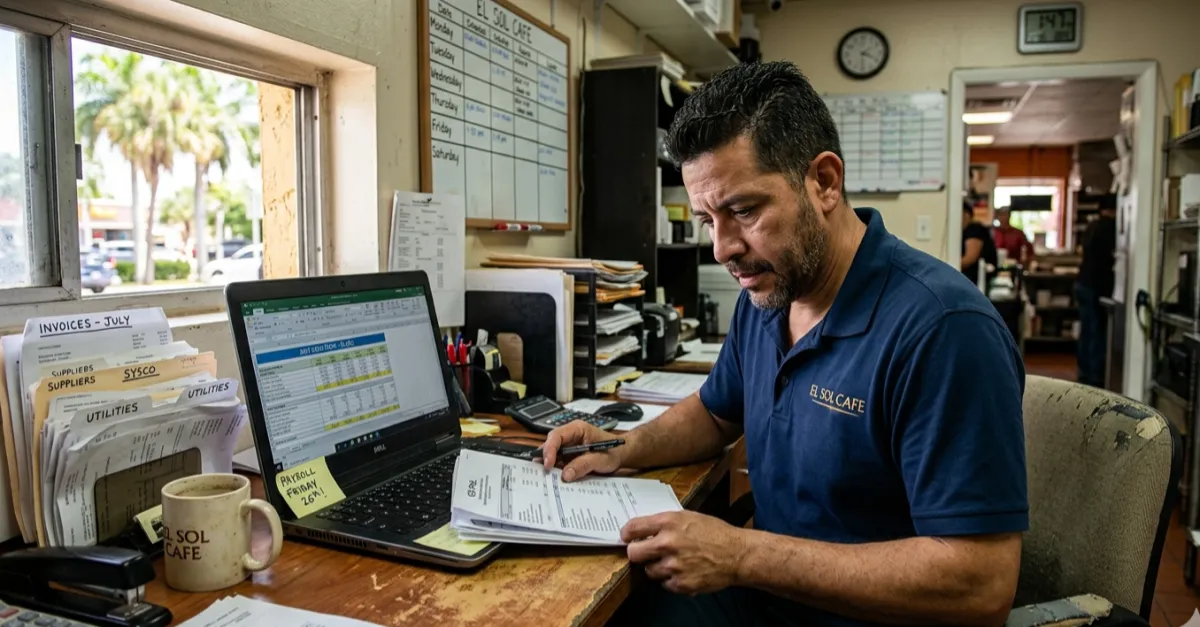
If you run a service business in South Florida — a gym, a couple of restaurants, a med spa, an HVAC or pool company doing somewhere between $500k and $5M a year — you know the rhythm. The snowbirds thin out, the part-time residents head north, and the summer slowdown starts pressing on your cash before the calendar even says August. Payroll doesn't slow down. Rent doesn't slow down. But the deposits do. And right around the time it gets tight, your phone lights up with someone offering you $80,000 "approved today, funds tomorrow."
I want to be straight with you, the way I'd be over coffee: that fast money is the single most expensive decision a lot of owners make all year — and in 2026, it's worse than expensive. A merchant cash advance you take in July to bridge a slow summer can now lock you out of the cheapest capital in the market — an SBA loan — for a year or more. Not because of the rate. Because of a rule change almost nobody is talking about. Let me show you what's actually happening, why the usual move backfires now, and what to do instead so you protect both this summer and next year's options.
What's actually happening this summer
The summer squeeze isn't a feeling — it's a measurable cycle. For seasonal and tourism-exposed businesses, the working-capital cycle stretches out by weeks during June through August, and the cash impact that starts in June peaks mid-July through mid-August and keeps rippling into September on delayed receivables (Trezy). The advice the planning playbooks give — build a reserve equal to three to six months of fixed costs, set aside 15–20% of peak-season profit — is correct (Trezy). The problem is most owners are reading that advice in June, when the window to act on it cleanly already closed in the spring.
So here's the real-world version I see every year. An owner with two restaurants doing about $2.2M combined hits a soft July. Receivables on the catering side are 40 days out, a walk-in cooler dies, and payroll lands on Friday. A cash-advance broker offers $90,000 at a 1.45 factor — meaning he pays back roughly $130,500 — with daily ACH withdrawals starting immediately. It solves Friday. It also pulls $1,000+ a day straight out of the business during the exact eight weeks cash is tightest, turning a soft summer into a death spiral he's still digging out of in November. That's the part the broker doesn't put on the term sheet.
Why it matters — and the 2026 mistake that quietly disqualifies you
Here's the change that makes this year different. Under the 2026 SBA rules (SOP 50 10 8), merchant cash advance debt can no longer be refinanced with an SBA loan (Frank). Read that again, because it's a trap a lot of good operators are about to walk into. In prior years, if you took an expensive advance to survive a rough patch, you could later clean it up by rolling it into a cheap SBA loan once your numbers recovered. That door is closed. The SBA will not approve a loan if any of the proceeds retire MCA debt — period. Your only path is to pay the advance off in full from operating cash flow or a non-SBA refinancefirst, and only then apply (Frank).
So the mistake isn't just "MCAs are expensive." It's that the fast money you grab to survive July is now a gate that stays shut on your SBA path for as long as the balance sits on your books. And it compounds. Every 7(a) Small Loan now requires a minimum 1.10x debt service coverage ratio, and a daily-debit MCA crushes the cash flow that ratio is measured on (Frank). You're not just blocked by the existence of the advance — you're also weakening the very numbers a lender uses to qualify you. The downstream cost isn't a percentage point. It's losing access to a sub-11% SBA option entirely, while you grind through a 60%+ effective-APR advance, and watching the operator down the street with a clean file buy the building or the competitor you wanted.
This is the structural truth nobody frames right: in 2026, the capital you take to survive this summer is really a decision about what capital you'll be allowed to access next year. Cash flow, SBA eligibility, and your future exit value are all the same conversation.
What to do instead
You can get through a slow summer without poisoning next year. Here's the playbook:
Run a 13-week cash forecast today. Project weekly inflows and outflows through September. Find the exact weeks you dip below your minimum operating balance. You can't solve a gap you haven't named.
Buy time on the outflow side first. Call your key suppliers now and ask for extended terms covering July–August. A request made in June is far easier than one made in panic in August.
Pull receivables forward. Offer a small early-payment discount on outstanding invoices. Cash in hand now beats full price in 50 days when you're tight.
If you must borrow, match the tool to the payoff — and protect the SBA path. A right-sized line of credit or a short, structured bridge designed to be refinanced into SBA financing keeps tomorrow's options open. An MCA does the opposite.
Never take an advance without modeling the daily debit against your slow-season forecast. If the daily pull pushes you below your floor in August, it's not a lifeline — it's the thing that sinks you.
Let's make sure this summer doesn't cost you next year
A slow summer is survivable. A bad capital decision in a slow summer is what does real damage. If you're a South Florida owner staring at a cash gap and a stack of "approved today" offers, send me what you're looking at before you sign anything — I'll tell you in plain language whether it's safe, whether it blocks your SBA path, and whether there's a smarter structure. Walk through your options with Bayside: https://baysidebusinessadvisors.com/explore-options